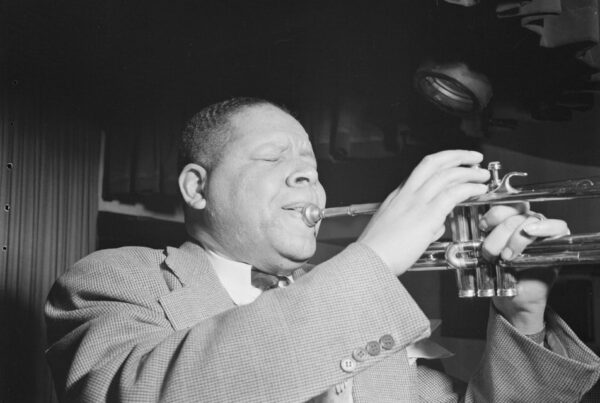

Visitors to New York should keep in mind that lots of great sites are outside of Manhattan. One of those is the Louis Armstrong House, which is in Corona, Queens. It’s a museum that is housed in the only home that Armstrong owned, and it is kept as it was when he passed away. It is not far from Citi Field.
Check out this nice feature from a while back at Retro Renovation.
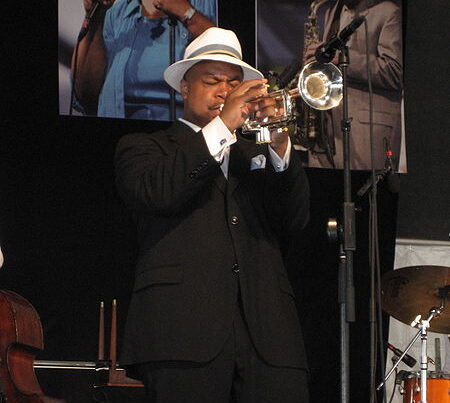
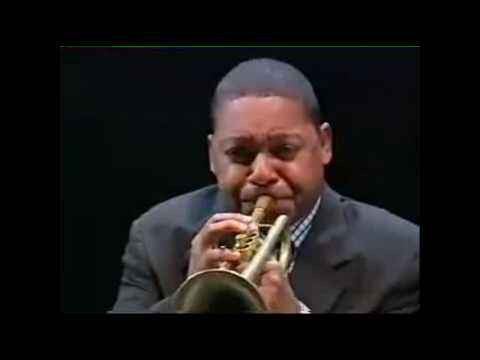
New Orleans has a genius for producing great food and great trumpet and cornet players. Indeed, Louis Armstrong — who Wynton Marsalis pays homage to above — wasn’t the first. There was Buddy Bolden. And Joe “King” Oliver, a mentor to Armstrong, was raised in New Orleans even if he wasn’t born there. More recently, the city produced Al Hirt and Nicolas Payton. There are many others.
But Marsalis is special, as a musician and as an ambassador of jazz. This is from the bio at his site:
Wynton was born in New Orleans, Louisiana, on October 18, 1961, to Ellis and Dolores Marsalis, the second of six sons. At an early age he exhibited a superior aptitude for music and a desire to participate in American culture. At age eight Wynton performed traditional New Orleans music in the Fairview Baptist Church band led by legendary banjoist Danny Barker, and at 14 he performed with the New Orleans Philharmonic. During high school Wynton performed with the New Orleans Symphony Brass Quintet, New Orleans Community Concert Band, New Orleans Youth Orchestra, New Orleans Symphony, various jazz bands and the popular local funk band, the Creators. (Continue Reading…)
Here is the beginning of a review of a 1999 work, All Rise, which was presented at Avery Fisher Hall:
Wynton Marsalis’s tap didn’t turn off in 1999. Eight new discs bear his name, ranging from new extended jazz works to rearranged Jelly Roll Morton and Thelonious Monk; he has a seven-CD boxed set of live material; six months of the year were spent touring worldwide and playing the music of Duke Ellington. And finally, in its premiere performance on Wednesday night at Avery Fisher Hall, there was ”All Rise,” a symphonic piece commissioned by the New York Philharmonic in a collaboration with Jazz at Lincoln Center. (Continue Reading…)
Above is Portrait of Louis Armstrong. It is, in essence, Marsalis’ take on Duke Ellington’s take on Armstrong. Below, Marsalis accompanies Norah Jones on Come Rain or Come Shine.
West End Blues by Louis Armstrong is one of the most important songs in jazz. A YouTube poster named pandasthumb describes the piece. It’s definitely worth checking out. Here is one paragraph from the post:
From the very first note of “West End Blues,” a tune composed by Joe “King” Oliver, one can immediately sense the shift that was occurring in jazz through Armstrong’s influence. From his introductory, fanfare-like opening to his solo later in the recording, Armstrong displays his power, range, and unique personality on the trumpet. Pianist Earl Hines is also featured.
Pandasthumb annotates the video with a description of what is going on and why it is special.
…Here at The Daily Music Break.
Terry Teachout, the drama critic for The Wall Street Journal, published a fabulous biography in late 2010 entitled Pops: A Life of Louis Armstrong. Here, Teachout is interviewed on C-SPAN by Brian Lamb, perhaps the best interviewer of our generation.
Note that Lamb starts out asking Teachout about his background. Once he builds that bridge, he moves on to Armstrong. One note: The embed seems to be acting a bit funny. After a few seconds it goes back to the beginning, but after that seems to play normally.
Louis Armstrong and Danny Kaye originally did this version of When the Saints Come Marching In in the movie The Five Pennies.
Genius isn’t inventing or developing something out of thin air. Rather, genius is taking elements that already exist and putting them together in a monumentally new way.
Albert Einstein, of course, is the prototypical genius. His most important breakthrough was taking work by Max Planck and others and transforming it into a theory that illuminated the relationship between energy and matter. He took the hints that the earlier scientists used for mathematical constructs necessary to make equations work–but which they didn’t think actually existed in nature–and showed that they were real and defined the behavior of light and, indeed, all matter. (That, in any case, is my limited understanding.)
What does this all have to do with Louis Armstrong? Plenty. Armstrong is the Einstein of modern music. There were other Bohrs, Feynmans and Hawkings (Ellington, Monk and Parker is the start of a pretty good list). But only one guy is at the top of the heap. That is Louis Armstrong. Miles Davis, who reportedly didn’t like Armstrong because of the way the latter presented himself to white audiences, acknowledged his stature:
“You can’t play anything on a horn that Louis hasn’t played.”
It isn’t that he necessarily was a greater talent than other jazz greats. It was the talent plus the luck of being there at the right moment. The world was ready for Einstein to discover the relationship between matter and energy that would lead to quantum physics. And Armstrong was in the right place at the right time as well: Jazz was ready to move from an ensemble to solo art form. Many can describe Armstrong’s role far better than I.
It’s also very interesting to note the similarities between the lives of the two men. Both were amazingly charismatic and led uniquely American lives. Both saw their breakthrough grow to be something with which they were uncomfortable: quantum mechanics and bebop. (The purest manifestation of Armstrong’s breakthrough, by the way, can be listened to. It is said to be the first 13 seconds of the beautiful West End Blues.)
Like most geniuses, Armstrong and Einstein had their breakthroughs early in the careers and had to deal with an unrealistic expectations for decades afterwards. This was difficult for both men.
Armstrong, in some critics’ eyes, stopped innovating and became a jolly reactionary fighting against the innovations he made possible. Einstein rebelled against the quantum world (“God does not play dice with the universe”) and embarked on a quixotic quest for the unified field theory. (During the past year, the controversy over results that initially indicated particles moving faster than light and the discovery of the Higgs Boson — a possible step toward a unified field theory — prove that a world of very brilliant people still is dealing with Einstein almost 60 years after he died.) Einstein’s research ended — literally — on his death bed.
There is one Einstein music story. He played violin in an orchestra at Princeton. He jumped in at the wrong point during one rehearsal. The conductor looked up and asked, “What’s the matter, Dr. Einstein? Can’t you count?”
Here Armstrong plays Hello Dolly! live (probably during the Korea era) and Mack the Knife.
Note: I am told by somebody who knows that the Hello Dolly! clip is from a military base in Texas in 1967, not Korea.
The song also is identified in the clip as The Kid From Red Bank. Basie was born in the New Jersey town in 1904. It certainly is a better title, unless there is a story attached to Whirly Bird.
Here is a musical bio of Basie. Albert Murray wrote this appreciation:
Indeed, Basie’s status as a great musician was not a matter of extension and elaboration of blues idiom basics as was the case of Louis Armstrong and Duke Ellington. Basie’s claim to fame and prestige was based on his refinement of the fundamentals that make jazz music swing.
The Basie hallmark was always simplicity, but it is a simplicity that is the result of a distillation that produced music that was as refined, subtle and elegant as it was earthy and robust. There is no better example of the ungaudy in the work of any other American artist in any medium.
The essay is part of a fabulous retrospective entitled ‘One More Once’: A Centennial Celebration of the Life and Music of Count Basie at the Rutgers University website.
Basie was discovered by John Hammond and got his musical education in Kansas City. Here are Jumpin at the Woodside and One O’Clock Jump, which perhaps are Basie’s most well known numbers.