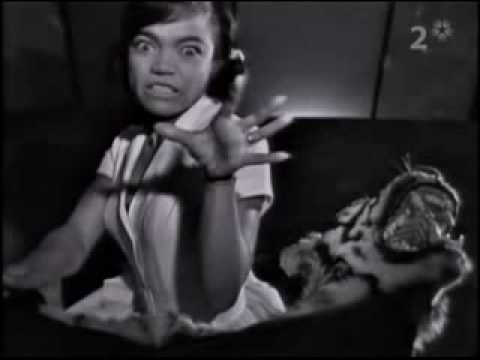
Eartha Kitt would have been 86 years old today. Above, she sings I Want to Be Evil, in a video that has one odd camera angle after another. Here is more on the sultry singer.
Also Sprach Zarathustra
As the bio below suggests, Eumir Deodato is by far best recognized for his version of Richard Strauss’ Also Sprach Zarathustra in 2001: A Space Odyssey. But his career obviously goes far beyond that great and agonizingly slow movie.
Widely regarded as one of the most respected and sought-after musicians in the music world, Brazilian-born Eumir Deodato has racked up 16 platinum records to his credit as artist, arranger or producer with combined sales of well over 25 million records in the USA alone. His discography, including compilations and all his work as arranger, producer and keyboardist, surpasses 450 albums. He has also had the honor of performing with the St. Louis Symphony (which backed him on his superb Artistry album), the Cincinnati Symphony, the New York Philharmonic and the Orchestra di Musica Leggera dell’Unione Musicisti di Roma. In addition, several artists over the years have covered his songs, including George Benson, Lee Ritenour, Sarah Vaughan and The Emotions to mention just a few. And yet, in spite of all of his varied triumphs, honors and distinctions over the years, the multi-talented, multi-instrumentalist will probably forever be associated with one song – his innovative rendition of Richard Strauss’ classical opus Also Sprach Zarathustra (or more commonly known as the theme to 2001: A Space Odyssey).
Here is the classical versions of Also Sprach Zarathustra and Rhapsody in Blue (featuring Leonard Bernstein). A bit of trivia: Deodato’s daughter is married to the actor Stephen Baldwin, according to Facebook.
Rhapsody in Blue
The CD turns 30 years old today. The Next Web notes that on Oct. 1, 1982, Billy Joel’s album 52nd Street – which initially was released in four years earlier – was re-released by Sony on a compact disk. The company simultaneously introduced the Sony CDP-101, the first CD player.
***
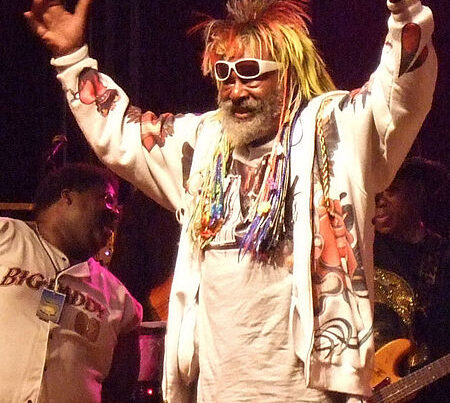
I don’t really understand it, from the spaceships landing and the guy in the diaper, but it all is very funky and the musicianship is great.
Believe it or not, Duke University has a Q and A on the band. Parliament and Funkadelic, it seems, are two distinct groups headed by George Clinton. Now I think I get it.
Here is an example of the Q&A, which is weirdly formatted:
8. What are the various aliases P.Funkers have used?
RC: ‘G Cook’, a name used in a number of Funkadelic writing credits, is really Eddie Hazel. It’s actually his mother’s name, Grace Cook.
‘J S Theracon’ is a name used by Junie Morrison at a time when he was under contract to another record company but still wanted to record with Parliament.
David Spradley has gone by a number of names, including ‘David Lee Chong’ and ‘Chong Spradley.’
George Clinton is known variously as ‘Dr. Funkenstein’, ‘Dr. Funk’, ‘Mr. Wiggles’, and ‘Starchild’. These are more characters than aliases, but he has been known to use them on personnel listings on album liner notes, in lieu of his real name.
Bootsy Collins has gone by ‘Casper (the funky/friendly/holy ghost)’, ‘Bootzilla’, ‘The Player’, ‘Zillatron’, and ‘Sugar Crook’.
Here are One Nation Under a Groove and Bootsy Collins’ I’d Rather Be with You.
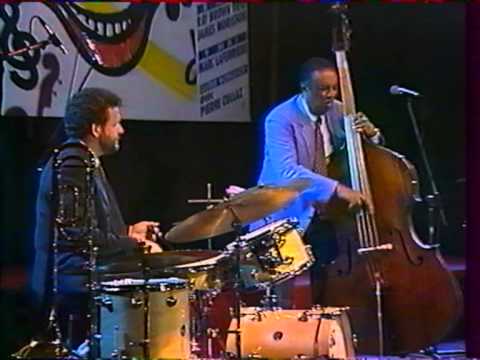
The beginning of NPR’s bio of bassist Ray Brown does a good job of quickly defining who he was — and the company he kept:
Grammy Award-winning double-bassist Ray Brown was a leader in defining the modern jazz rhythm section — in addition to being a first-rate soloist. His unique dynamic and innate sense of swing graced performances by Dizzy Gillespie, Ella Fitzgerald, Duke Ellington, Oscar Peterson and countless others.
Bebop was great music, but it could be intellectual and inaccessible. Brown’s allmusic bio, which is on the same page as Brown’s discography, hints at a player who wasn’t as challenging to listeners as many who played in his era:
The huge and comfortable sound of Ray Brown’s bass was a welcome feature on bop-oriented sessions for over a half-century.
Brown was married to Ella Fitzgerald from 1947 to 1952. This is from his obituary in The New York Times, which ran on July 4, 2002:
Mr. Brown won numerous critics’ and listeners’ popularity polls, and was regularly included among the half-dozen or so greatest of all jazz bassists, along with Oscar Pettiford, Charles Mingus, Milt Hinton, and Jimmy Blanton, whose performances with Duke Ellington he counted among his greatest influences.
Here are Five O’Clock Whistle and Things Ain’t What They Used to Be. Kevin Mahogany’s vocal on Yardbird Suite hints at rap and hip-hop styles that still were decades in the future.
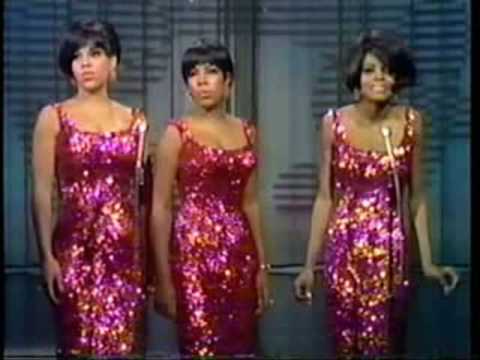
A couple of Supremes notes for June 30. You Keep Me Hanging On was recorded on this day in 1966. It also is the birthday of Florence Ballard, one of the original members of the group. Like so many in rock and roll, it is not a happy story, according to allmusic:
In mid-1967, as a result of what was deemed increasingly unprofessional behavior, Ballard was replaced by Cindy Birdsong (from Patti LaBelle & the Bluebelles). Ballard become one of rock’s greatest tragedies, eventually ending up on welfare, and dying in 1976.
Ballard was born in 1943 and died in 1976 at age 32. Here is more on Ballard at NNDB.
This morning the site featured The Blasters, who are heavily influenced by rockabilly. In this video, the great Imelda May suggests that rockabilly started a lot of the most talented performers of the 20th century — Bruce Springsteen, Jeff Beck, The Beatles, The Rolling Stones and Bob Dylan, to name a few — on the road to the great places they ended up.
May mentions Elvis, Gene Vincent, Johnny Burnette, Carl Perkins and Wanda Jackson as particularly important figures in rockabilly. Her song choice for Vincent (and his Blue Caps) is Baby Blue — but I am sure she wouldn’t object to this high quality recording of Be Bop a Lupa.
Bobby Darin — born in 1936 as Robert Walden Cassotto in the Bronx — accomplished a lot in his life, which only lasted 34 years. Here is a short bio and a long one. This is the first paragraph from the short one, which is at the Rock and Roll Hall of Fame website:
Bobby Darin was one of the most ambitious and versatile performers of the last 60 years. He straddled generations, appealing to bobbysoxers as a teen idol who wrote and recorded “Splish Splash” in 1958 and then winning over their parents as the swaggering, Sinatra-voiced adult who cut the ultimate version of “Mack the Knife” (a song from Bertolt Brecht and Kurt Weill’s musical Threepenny Opera) only a year later. Both songs were enormous hits, with “Splish Splash” reaching Number Three and “Mack the Knife” topping the chart for an astounding nine weeks. Darin’s range was as boundless as his brash self-confidence. In 1959, he told a Life magazine reporter that he wanted to be a pop legend by the age of 25, while he allegedly informed another writer that he intended to surpass Frank Sinatra.
Louis Armstrong and Ella Fitzgerald did fabulous versions of Mack the Knife, so pronouncing Darin’s the best is not fair. But the rest of this long paragraph captures the bottom line: Darin was a very talented guy. He also seems to have matured as quickly as some of the rock-and-roll bands that followed.
Here are Across the Sea, Mack the Knife (you decide: Here are Armstrong’s and Fitzgerald’s versions) and Artificial Flowers. There also are two clips that deal with trains: a medley with Judy Garland from her show and revealing footage of Darin relaxing and playing guitar while riding. He plays the beginning of a song he is working on that sounds like it could have been written by Woody Guthrie.