Posts Tagged: Duke Ellington

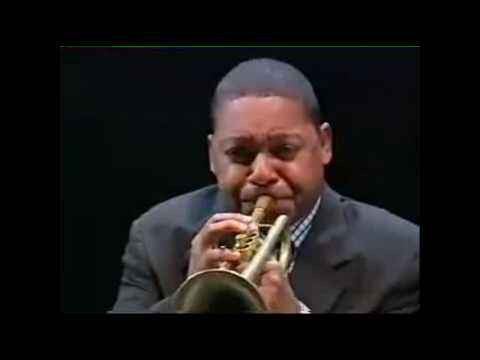
Wynton Marsalis: Portrait of Louis Armstrong and Come Rain or Come Shine

New Orleans has a genius for producing great food and great trumpet and cornet players. Indeed, Louis Armstrong — who Wynton Marsalis pays homage to above — wasn’t the first. There was Buddy Bolden. And Joe “King” Oliver, a mentor to Armstrong, was raised in New Orleans even if he wasn’t born there. More recently, the city produced Al Hirt and Nicolas Payton. There are many others.

But Marsalis is special, as a musician and as an ambassador of jazz. This is from the bio at his site:

Wynton was born in New Orleans, Louisiana, on October 18, 1961, to Ellis and Dolores Marsalis, the second of six sons. At an early age he exhibited a superior aptitude for music and a desire to participate in American culture. At age eight Wynton performed traditional New Orleans music in the Fairview Baptist Church band led by legendary banjoist Danny Barker, and at 14 he performed with the New Orleans Philharmonic. During high school Wynton performed with the New Orleans Symphony Brass Quintet, New Orleans Community Concert Band, New Orleans Youth Orchestra, New Orleans Symphony, various jazz bands and the popular local funk band, the Creators. (Continue Reading…)

Here is the beginning of a review of a 1999 work, All Rise, which was presented at Avery Fisher Hall:

Wynton Marsalis’s tap didn’t turn off in 1999. Eight new discs bear his name, ranging from new extended jazz works to rearranged Jelly Roll Morton and Thelonious Monk; he has a seven-CD boxed set of live material; six months of the year were spent touring worldwide and playing the music of Duke Ellington. And finally, in its premiere performance on Wednesday night at Avery Fisher Hall, there was ”All Rise,” a symphonic piece commissioned by the New York Philharmonic in a collaboration with Jazz at Lincoln Center. (Continue Reading…)

Above is Portrait of Louis Armstrong. It is, in essence, Marsalis’ take on Duke Ellington’s take on Armstrong. Below, Marsalis accompanies Norah Jones on Come Rain or Come Shine.

facebooktwittergoogle_plusredditpinterestlinkedinmailby feather

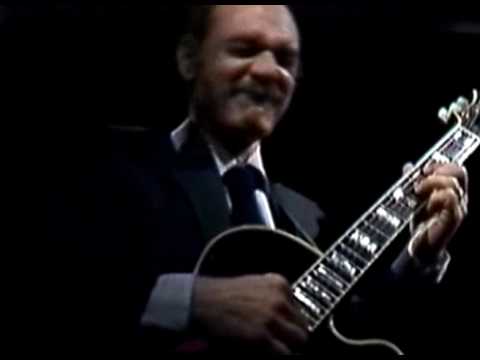
The Great Joe Pass

This site celebrates Joe Pass. AllMusic does its usual nice job of profiling the great and iconic The jazz guitarist:

Joe Pass did the near-impossible. He was able to play up-tempo versions of bop tunes such as “Cherokee” and “How High the Moon” unaccompanied on the guitar. Unlike Stanley Jordan, Pass used conventional (but superb) technique, and his Virtuoso series on Pablo still sounds remarkable decades later.

Joe Pass had a false start in his career. He played in a few swing bands (including Tony Pastor’s) before graduating from high school, and was with Charlie Barnet for a time in 1947. But after serving in the military, Pass became a drug addict, serving time in prison and essentially wasting a decade. He emerged in 1962 with a record cut at Synanon, made a bit of a stir with his For Django set, recorded several other albums for Pacific Jazz and World Pacific, and performed with Gerald Wilson, Les McCann, George Shearing, and Benny Goodman (1973). (Continue Reading…)

Above is Joe’s Blues and below is the Billy Strayhorn/Duke Ellington composition Satin Doll. Pass describes his approach to improvisation at the end of Joe’s Blues.

facebooktwittergoogle_plusredditpinterestlinkedinmailby feather

Stevie Wonder: Superstition, Sir Duke and I Wish

Stevie Wonder needs no introduction. His bio may not be well known by all but his most ardent fans, however. Here is how the version at Encyclopedia Britannica starts:

Stevie Wonder, original name Steveland Judkins or Steveland Morris (born May 13, 1950, Saginaw, Mich., U.S.), American singer, songwriter, and multi-instrumentalist, a child prodigy who developed into one of the most creative musical figures of the late 20th century.

Blind from birth and raised in inner-city Detroit, he was a skilled musician by age eight. Renamed Little Stevie Wonder by Berry Gordy, Jr., the president of Motown Records—to whom he was introduced by Ronnie White, a member of the Miracles—Wonder made his recording debut at age 12. The soulful quality of his high-pitched singing and the frantic harmonica playing that characterized his early recordings were evident in his first hit single, “Fingertips (Part 2),” recorded during a show at Chicago’s Regal Theatre in 1963. But Wonder was much more than a freakish prepubescent imitation of Ray Charles, as audiences discovered when he demonstrated his prowess with piano, organ, harmonica, and drums. By 1964 he was no longer described as “Little,” and two years later his fervent delivery of the pounding soul of “Uptight (Everything’s Alright),” which he also had written, suggested the emergence of both an unusually compelling performer and a composer to rival Motown’s stable of skilled songwriters. (He had already cowritten, with Smokey Robinson, “The Tears of a Clown.”) Continue Reading…

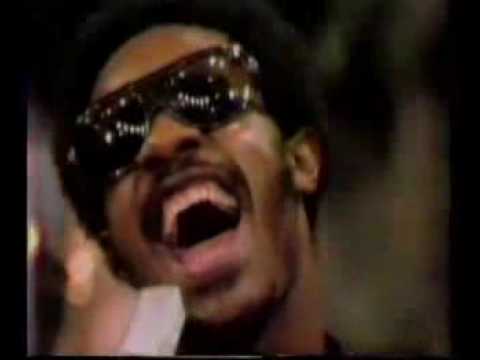
Here is one of Wonder’s sites. Above is a great version of Superstition on Sesame Street, of all places. Below is Sir Duke – a tribute to Duke Ellington and other jazz greats — and I Wish.

facebooktwittergoogle_plusredditpinterestlinkedinmailby feather

Ray Brown: Lady Be Good


The beginning of NPR’s bio of bassist Ray Brown does a good job of quickly defining who he was — and the company he kept:

Grammy Award-winning double-bassist Ray Brown was a leader in defining the modern jazz rhythm section — in addition to being a first-rate soloist. His unique dynamic and innate sense of swing graced performances by Dizzy Gillespie, Ella Fitzgerald, Duke Ellington, Oscar Peterson and countless others.

Bebop was great music, but it could be   intellectual and  inaccessible. Brown’s allmusic bio, which is on the same page as Brown’s discography, hints at a player who wasn’t as challenging to listeners as many who played in his era:

The huge and comfortable sound of Ray Brown’s bass was a welcome feature on bop-oriented sessions for over a half-century.

Brown was married to Ella Fitzgerald from 1947 to 1952. This is from his obituary in The New York Times, which ran on July 4, 2002:

Mr. Brown won numerous critics’ and listeners’ popularity polls, and was regularly included among the half-dozen or so greatest of all jazz bassists, along with Oscar Pettiford, Charles Mingus, Milt Hinton, and Jimmy Blanton, whose performances with Duke Ellington he counted among his greatest influences.

Here are Five O’Clock Whistle and Things Ain’t What They Used to BeKevin Mahogany’s vocal on Yardbird Suite hints at rap and hip-hop styles that still were decades in the future.

facebooktwittergoogle_plusredditpinterestlinkedinmailby feather

Count Basie: Whirly Bird

The song also is identified in the clip as The Kid From Red Bank. Basie was born in the New Jersey town in 1904. It certainly is a better title, unless there is a story attached to Whirly Bird.

Here is a musical bio of Basie. Albert Murray wrote this appreciation:

Indeed, Basie’s status as a great musician was not a matter of extension and elaboration of blues idiom basics as was the case of Louis Armstrong and Duke Ellington. Basie’s claim to fame and prestige was based on his refinement of the fundamentals that make jazz music swing.

The Basie hallmark was always simplicity, but it is a simplicity that is the result of a distillation that produced music that was as refined, subtle and elegant as it was earthy and robust. There is no better example of the ungaudy in the work of any other American artist in any medium.

The essay is part of a fabulous retrospective entitled ‘One More Once’: A Centennial Celebration of the Life and Music of Count Basie at the Rutgers University website.

Basie was discovered by John Hammond and got his musical education in Kansas City. Here are Jumpin at the Woodside and One O’Clock Jumpwhich perhaps are Basie’s most well known numbers.

facebooktwittergoogle_plusredditpinterestlinkedinmailby feather

Duke Ellington and Jimmy Stewart

In a post about Henry Mancini earlier this week, I linked to an iMDB bio that mentioned the relationship between jazz and movies.

Along those lines, check out this clip of Duke Ellington and Jimmy Stewart in the movie Anatomy of a Murder. Considering that the movie was made in 1959, it’s an amazingly forthright treatment of sex and violence. The music is very cool, to boot.


facebooktwittergoogle_plusredditpinterestlinkedinmailby feather

Ben Webster: Old Folks

The comments to the above clip point out that Ben Webster clearly is crying after Teddy Wilson’s piano solo. The explanation provided — there is no way to verify it, of course — is that Johnny Hodges, with whom Webster had played in Duke Ellington’s band, had just passed away.

Everything Webster played was beautiful. One story that I read in more than one place is that when Webster began rehearsing a song that had lyrics he would learn those words in order to play them on his sax.

Here is Flying Home — the tune I originally was going to embed until Old Folks popped up — The Brute, C-Jam Blues, Chelsea Bridge and Over the Rainbow. The New Yorker did a piece on Webster about ten years ago. Basic biographical information and discographies can be found on many sites dedicated to Webster, including these two.

A special acknowledgement is due to the JazzVideoGuy, who initially posted a lot of these clips and others that I use. He does a terrific job of, well, doing what his name says.

_______________


facebooktwittergoogle_plusredditpinterestlinkedinmailby feather

Billy Taylor, Willie “The Lion” Smith and Duke Ellington: Perdido

A list of Duke Ellington songs is like a list of those from the Rolling Stones, the Beatles, Bob Dylan and a few others. The song are so familiar and deeply connected to the culture that in a way they don’t even belong to the artist any longer. They are part of the bigger soundtrack.

The above version of Perdido features three famous pianists. There is Ellington in front, and Billy Taylor, who passed away in late 2010, in the back.

In the middle with the cigar is Willie “The Lion” Smith, a legendary stride piano player and mentor to Ellington. Smith was different. In an affectionate post jazz critic Nat Hentoff quotes Smith through pianist Spike Wilner:

…”A lot of people are unable to understand my wanting to be Jewish. One said to me, ‘ Lion, you stepped up to the plate with one strike against you and now you take a second one right down the middle! They can’t seem to realize I have a Jewish soul and belong to that faith.” (Editor’s note: In his 1965 autobiography, Music On My Mind, Smith also states that his birth father, Frank Bertholoff, was Jewish.)

Here is some vintage Ellington. He performs Take the A Train beautifully in a small group setting. Others standards are C Jam Blues, Mood Indigo, It Don’t Mean a Thing and Satin Doll. No posting concerning Ellington would be complete without mention of his alter ego, Billy Strayhorn, who wrote Take the A Train. Here he plays and sings Lush Life.


facebooktwittergoogle_plusredditpinterestlinkedinmailby feather