
Dark Side of the Moon was released on March 1, 1973. In honor of the album’s fortieth anniversary, Forbes’ contributor Michele Catalano has an appreciation which in part reads:
Dark Side was not an album of hits, though. It was a concept album, something to be listened to from start to finish with the only pause being the twenty seconds it took you to flip from side one to two. While other people saw its meaning in other things – such as syncing it up to The Wizard of Oz – the true appeal and wonderment of Dark Side of the Moon was in the entirety of the story within. No, it’s not a story in the truest sense, not like The Wall, but there is a deeper story within the songs, one that each listener interpreted differently or related to their own lives and mindsets in different ways. It reached millions of people on a deep level because there was a different story in between the lines for everyone. Madness, death, the passing of time, greed, tension. Everything you needed to fuel your existential crisis was found within the grooves of Dark Side of the Moon. (Continue Reading…)
It is strange that the band wasn’t inducted into the Rock & Roll Hall of Fame until 1996, which was the eleventh class of inductees. Here is the beginning of the profile at the site:
Pink Floyd’s hallucinatory presentation of lights and music at London’s Roundhouse in 1966 brought psychedelia to the U.K. scene. The group carried rock and roll into a dimension that was more cerebral and conceptual than what preceded it. What George Orwell and Ray Bradbury were to literature, Pink Floyd is to popular music, forging an unsettling but provocative combination of science fiction and social commentary. In their early years, with vocalist, guitarist and songwriter Syd Barrett at the helm, Pink Floyd were the psychedelic Pied Pipers of the “London underground” scene. In the Seventies, with bassist Roger Waters providing more of the songwriting and direction, Pink Floyd became one of the most influential rock bands of all time.
Before they settled on Pink Floyd, the group went by the names Sigma 6 and the Architectural Abdabs, and they mainly performed rhythm and blues covers. Singer-guitarist Syd Barrett provided Pink Floyd with most of its original early material, including the British hits “See Emily Play” and “Arnold Layne.” Barrett’s elfin, tuneful psychedelia made him the Lewis Carroll of the pop scene. Pink Floyd’s debut album, Piper at the Gates of Dawn, is a classic of psychedelic whimsy that epitomized the remarkable year of 1967 at its most playful and creative. As the British music magazine Q opined in 1995, “Piper at the Gates of Dawn is, even counting Sgt. Pepper, possibly the defining moment of English psychedelia and Syd Barrett’s magnum opus.” Among its highlights was a nine-minute instrumental, “Interstellar Overdrive,” that represented one of rock’s first forays into deep space. It was a preoccupation of Pink Floyd’s that would later surface in songs like “Set the Controls for the Heart of the Sun” (from A Saucerful of Secrets) and the group’s masterwork, Dark Side of the Moon. (Continue Reading…)
I’m using the Vimeo version of the great Another Brick in the Wall video. It is clearer and, despite the subtitles, easier to watch than the YouTube version. The person who posted it at YouTube noted that the video actually is a combination of Another Brick in the Wall Part 2 and The Happiest Days of Our Lives.
“Another Brick In The Wall” – Pink Floyd from Kiarostami on Vimeo.
This is one of the most interesting bios I’ve read while doing this site. Dick Dale is most associated with the development of surf music. The profile discusses his mid Eastern roots — which explains why Hava Nagila was part of his repertoire — his influence on Jimi Hendrix and others, his pushing the envelop on amplification and his status as one of the godfathers of heavy metal. This is how it starts:
Dick Dale (born Richard Anthony Monsour on May 4, 1937) is a Lebanese American surf rock guitarist, known as The King of the Surf Guitar. He pioneered the surf music style, drawing on Eastern musical scales and experimenting with reverberation. He worked closely with Fender to produce custom made amplifiers,[1] including the first-ever 100-watt guitar amplifier.[2] He pushed the limits of electric amplification technology, helping to develop new equipment that was capable of producing distorted, “thick, clearly defined tones” at “previously undreamed-of volumes.” The “breakneck speed of his single-note staccato picking technique” as well as his showmanship with the guitar is considered a precursor to heavy metal music, influencing guitarists such as Jimi Hendrix and Eddie Van Halen.[1] (Continue Reading…)
AllMusic chimes in:
Dick Dale wasn’t nicknamed “King of the Surf Guitar” for nothing: he pretty much invented the style single-handedly, and no matter who copied or expanded upon his blueprint, he remained the fieriest, most technically gifted musician the genre ever produced. Dale‘s pioneering use of Middle Eastern and Eastern European melodies (learned organically through his familial heritage) was among the first in any genre of American popular music, and predated the teaching of such “exotic” scales in guitar-shredder academies by two decades. The breakneck speed of his single-note staccato picking technique was unrivalled until it entered the repertoires of metal virtuosos like Eddie Van Halen, and his wild showmanship made an enormous impression on the young Jimi Hendrix. But those aren’t the only reasons Dale was once called the father of heavy metal. Working closely with the Fender company, Dalecontinually pushed the limits of electric amplification technology, helping to develop new equipment that was capable of producing the thick, clearly defined tones he heard in his head, at the previously undreamed-of volumes he demanded. He also pioneered the use of portable reverb effects, creating a signature sonic texture for surf instrumentals. And, if all that weren’t enough, Dale managed to redefine his instrument while essentially playing it upside-down and backwards — he switched sides in order to play left-handed, but without re-stringing it (as Hendrix later did). (Continue Reading…)
Here is Dale’s site and an interesting clip of his views on the music business. Above is a medly comprised of Surfin’ & Swingin’, Misirlou and Wedge. Below is Hava Nagila. A site called Rocktober did a long interview with Dale in 1994.
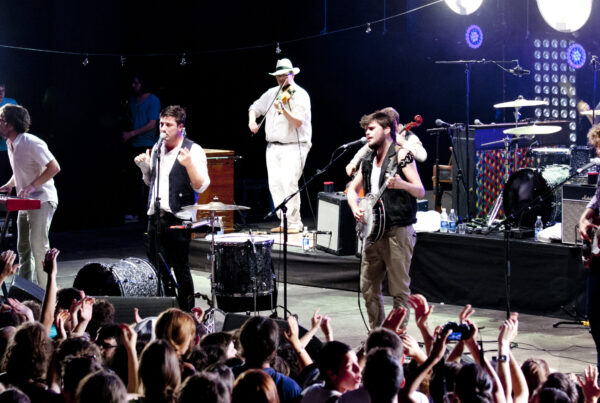
Mumford & Sons’ Babel won the 2012 Grammy Award for best album. Here is the beginning of Wikipedia’s profile of the band:
Mumford & Sons are an English folk rock band. The band consists of Marcus Mumford (lead vocals, guitar, drums, mandolin), Ben Lovett (vocals, keyboards, accordion, drums), Winston Marshall (vocals, banjo, guitar, resonator guitar), and Ted Dwane (vocals, string bass, drums, guitar). Mumford & Sons were formed in December 2007, emerging out of West London, with such artists as Laura Marling, Johnny Flynn and Noah and the Whale.
Mumford & Sons recorded an EP, Love Your Ground, and performed in small to moderate venues in the UK and the United States to expose audiences to their music and build support for an eventual album. Their debut album, Sigh No More, was released in the UK and Ireland in October 2009, and February 2010 in the US. The album reached number one in Ireland, Australia and New Zealand, and eventually peaked at number two on the UK Albums Chart and the Billboard 200 in the US. The band gained popularity throughout 2010, performing for larger audiences and making their first network television appearances in the US. On 1 December 2010, the band received two Grammy Award nominations, one for Best New Artist and the other for Best Rock Song (“Little Lion Man”). The ensuing live performance at the Grammy ceremony in February 2011 led to increased airplay and popularity for singles from Sigh No More. The band won the ARIA Music Award for Most Popular International Artist in 2010, and the Brit Award in 2011 for Best British Album. (Continue Reading…)
The band is working on with Justin Timberlake on the soundtrack for the next Coen Brothers’ film. Above is Little Lion Man and below is Dust Bowl Dance. The band’s website has a lot of information, including dates for the current European tour. Mumford & Sons will play domestic dates starting in mid June.
This autobiographical post at Leo Kottke’s site probably says as much about the great guitarist as a traditional bio. The guy can write. Here is the start:
TROMBONE
Studying with three teachers in three years, I was a trombone student in Oklahoma until I was about fifteen years old. Each weekend at one of their houses I’d wait in the kitchen until the trombonist in the basement would yell up at me to come down– they taught in their basements. I would descend, assemble my horn, sit in a folding chair, park my sheet music on the stand, weather some insult aimed at my embouchure, and play whatever I had not been studying for the last week.
My teachers– industrious, frugal, starving men– had one thing in common other than my unpreparedness: they’d all installed do-it-yourself showers in those basements. These units stood in some corner, usually my corner, and they’d drip… ploink, ploink. There was nothing more ominous than basements with leaking showers in them, and there was no telling when fear began, but my trombone kept those home improvements at bay. (Continue Reading…)
This Last.fm bio is more traditional — and no less interesting:
Leo Kottke (born September 11, 1945 in Athens, Georgia) is a legendary acoustic guitar virtuoso who has developed a cult following of fellow guitarists and fans over the span of a 30-year career of recording and performing.
Blending folk, jazz, and blues influences into a signature finger-picked style of syncopated, polyphonic music, Kottke’s work pre-dated and predicted much of the New Age instrumental music movement, and is often considered part of the American Primitivism movement, partly because he was signed to John Fahey’s Takoma Records label.
Kottke has collaborated on his records with his mentor John Fahey, Chet Atkins, Lyle Lovett, Margo Timmins of the Cowboy Junkies, and Rickie Lee Jones. He has recorded tunes by Tom T. Hall, Johnny Cash, Carla Bley, Fleetwood Mac, The Byrds, Jorma Kaukonen, Kris Kristofferson, Randall Hylton and many others. He is also a frequent guest on the radio variety program A Prairie Home Companion.
Kottke has recently joined up with Phish bassist Mike Gordon to produce two new albums, clone and sixty six steps. This duo created a new tone resembling what can be described almost like island music. (Continue Reading…)
The top song, Vaseline Machine Gun, probably is Kottke’s best known song. This version was the second half of a CNN interview, which is pretty interesting. The music starts at about 1:45 and the end is cut off, but it probably is the best video on YouTube of the song. Last Steam Engine –which was written by John Fahey – is below.
David Bromberg stands out even in a landscape in which there are many talented and eccentric acts. He is part rock-and-roll and blues royalty — he took lessons from Rev. Gary Davis — and part Borscht Belt comedian. The bottom line is that he has been making great music for decades. Some of it is slow and thoughtful acoustic blues and some of it is over-the-top ADHD fun.
Unfortunately, this great version of Oh, Sharon can’t be embedded. I recommend it. The song has one of the great verses in rock:
Oh, Sharon,
What do you do to these men?
You know, the same rowdy crowd that was here last night
Is back again.
This interesting interview with Holgar Peterson touches on many topics, including Bromberg’s relationship with Davis. Here is the beginning of the bio at his site:
He’s played with everyone, he’s toured everywhere, he can lead a raucous big band or hold an audience silent with a solo acoustic blues. Here’s the story of David Bromberg, or at least some of it…
Born in Philadelphia in 1945 and raised in Tarrytown, NY, “as a kid I listened to rock ’n’ roll and whatever else was on the radio,” says Bromberg. “I discovered Pete Seeger and The Weavers and, through them, Reverend Gary Davis. I then discovered Big Bill Broonzy, who led me to Muddy Waters and the Chicago blues. This was more or less the same time I discovered Flatt and Scruggs, which led to Bill Monroe and Doc Watson.”
Bromberg began studying guitar-playing when he was 13 and eventually enrolled in Columbia University as a musicology major. The call of the Greenwich Village folk scene in the mid-’60s drew David to the downtown clubs and coffeehouses, where he could watch and learn from the best performers, including primary sources such as his inspiration and teacher, the Reverend Gary Davis. Continue Reading…
The Detroit Metro Times lists more than 100 top songs from in and around the city. Here are its top ten:
Of course, great Detroit area acts such as Gladys Knight & the Pips, The Temptations, Eminem and Bob Seeger and the Silver Bullet Band are represented on the long and interesting list.
Professor Longhair was a New Orleans piano player who greatly influenced Dr. John. Here is the first paragraph of an interesting site dedicated to the colorful and eccentric musician:
Henry Roeland Byrd (a.k.a Professor Longhair) was Born in Bogalusa, Louisiana, on December 19, 1918. The Henry Roeland Byrd story is fundamentally the story of an artist who created his own musical world, constantly refining and elaborating a distinctive personal style. It may have been too idosyncratic to ever capture mainstream popularity during Longhair’s lifetime, but it was so striking and individual that it ultimately became the definitive standard for New Orleans piano players. Continue Reading…
Here is more, from Alligator Records:
New Orleans is said to be a city where having a party has been elevated from a casual pastime to a way of life. Nobody understood this better than Professor Longhair, one of the pioneers of New Orleans rhythm & blues. His influence can be heard in Fats Domino, Allen Toussaint and Dr. John, among many others. Known for his unique mix of blues, jazz, calypso, ragtime, and zydeco, “Fess” (as he was known) defined and captured the essence of New Orleans in his music. Born Henry Roeland Byrd in Bogalusa, Louisiana 1918, and raised in New Orleans, Fess started performing at an early age, often dancing down Bourbon Street for tips. Continue Reading…
Above is Big Chief and below is Tipitina.
Bill Monroe (1911-1996) is known as the Father of Bluegrass Music. His very nice site offers a tremendous amount of information. Here is the beginning of a piece that creates a nice bit of context around this important figure in American music:
Country music has been examined by many authors, both in print and on the Internet, trying to explain it in intellectual terms – often with bewildering confusion. And the part of country music that has been analyzed the most is bluegrass. This is surprising since it is its pure simplicity, accompanied by outstanding musicians, which has attracted such a large audience to bluegrass. Bill Monroe, the Father of Bluegrass Music, explained it this way: “To me bluegrass is really THE country music. It was meant for country people.” Therefore, it is surprising that bluegrass gained strong support in urban areas at a time when the trend was to popularize country music. It took a proud, stubborn man like Bill Monroe to resist the pop tide and make bluegrass what it is today. Continue Reading…
Here is more a bio at AllMusic, written by Steven Thomas Erlewine:
Bill Monroe is the father of bluegrass. He invented the style, invented the name, and for the great majority of the 20th century, embodied the art form. Beginning with his Blue Grass Boys in the ’40s,Monroe defined a hard-edged style of country that emphasized instrumental virtuosity, close vocal harmonies, and a fast, driving tempo. The musical genre took its name from the Blue Grass Boys, andMonroe‘s music forever has defined the sound of classical bluegrass — a five-piece acoustic string band, playing precisely and rapidly, switching solos and singing in a plaintive, high lonesome voice. Not only did he invent the very sound of the music, Monroe was the mentor for several generations of musicians. Over the years, Monroe‘s band hosted all of the major bluegrass artists of the ’50s and ’60s, including Flatt & Scruggs, Reno & Smiley, Vassar Clements, Carter Stanley, and Mac Wiseman. Though the lineup of the Blue Grass Boys changed over the years, Monroe always remained devoted to bluegrass in its purest form. Continue Reading…
There is an old joke about a musician who dies and goes to heaven. He sees a man sitting on a cloud playing mandolin and remarks to Saint Peter that it’s nice to see Bill Monroe again. “Actually, that’s God,” Saint Peter says. “Every once in a while he likes to make believe he’s Bill Monroe.”
Above is Rawhide and below is Sally Goodwin (with Doc Watson). Here are some great clips linked to from Monroe’s site.