
Posts Tagged: blues music

B.B. King: The Thrill is Not Gone

B.B. King is introduced in the above clip by Jimmy Walker, of Good Times fame (Dy-no-mite!). The song is of How Blue Can You Get? Below King sings Just a Little Bit of Love on a show hosted by David Steinberg, another 1970s/80s television comedian. David Brenner and Nipsy Russell aren’t far behind.

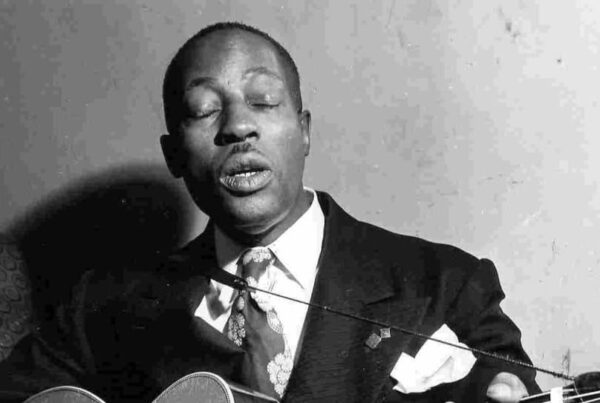
B.B. King, of course, is one of the most important musicians the U.S. has produced. This is the beginning of the bio at his website:

His reign as King of the Blues has been as long as that of any monarch on earth. Yet B.B. King continues to wear his crown well. At age 76, he is still light on his feet, singing and playing the blues with relentless passion. Time has no apparent effect on B.B., other than to make him more popular, more cherished, more relevant than ever. Don’t look for him in some kind of semi-retirement; look for him out on the road, playing for people, popping up in a myriad of T.V. commercials, or laying down tracks for his next album. B.B. King is as alive as the music he plays, and a grateful world can’t get enough of him. (Continue Reading…)

King was inducted into the Rock and Roll Hall of Fame in 1987. Here is part of the very well written bio at the Hall’s site:

As a guitarist, King is best-known for his single-note solos, played on a hollowbody Gibson guitar. King’s unique tone is velvety and regal, with a discernible sting. He’s known for his trilling vibrato, wicked string bends, and a judicious approach that makes every note count. Back in the early days, King nicknamed his guitar “Lucille,” as if it were a woman with whom he was having a dialogue. In fact, King regards his guitar as an extension of his voice (and vice versa). “The minute I stop singing orally,” King has noted, “I start to sing by playing Lucille.”

There have been many Lucilles over the years, and Gibson has even marketed a namesake model with King’s approval. King selected the name in the mid-Fifties after rescuing his guitar from a nightclub fire started by two men arguing over a woman. Her name? Lucille. (Continue Reading…)

It’s interesting that one of King’s early  influences was his cousin, Bukka White. Here is a great version of The Thrill Is Gone, King’s signature song.

facebooktwittergoogle_plusredditlinkedinmailby feather

Roomful of Blues: Slam Jam and Back Seat Blues

Here is the beginning of Wikipedia’s profile of Room Full of Blues:

Roomful of Blues is an American blues and swing revival big band based in Rhode Island. With a recording career that spans over 40 years, they have toured worldwide and recorded many albums. Roomful of Blues, according to The Chicago Sun-Times, “Swagger, sway and swing with energy and precision”.[1] Since 1967, the group’s blend of swing, rock and roll, jump blues, boogie-woogie and soul has earned it five Grammy Award nominations and many other accolades, including seven Blues Music Awards (with a victory as Blues Band Of The Year in 2005). Billboard called the band “a tour de force of horn-fried blues…Roomful is so tight and so right.”[2] The Down Beat International Critics Poll has twice selected Roomful of Blues as Best Blues Band. (Continue Reading…)

AllMusic takes another tack:

Over the course of their decades-long existence, Roomful of Blues effectively became a franchise unto themselves, built more on a brand-name collective identity than on the voices of the myriad individual members who kept the band a smoothly humming machine. Describing Roomful of Blues that way, however, gives short shrift to the many accomplished musicians who have emerged from the band’s ranks over the years: guitarists Duke Robillard and Ronnie Earl, organist Ron Levy, pianist Al Copley, singer Lou Ann Barton, vocalist/harmonica player Sugar Ray Norcia, and drummer Fran Christina (later of the Fabulous Thunderbirds), to name the most prominent. Plus, the band’s horn section blossomed into a renowned freelancing unit, backing countless other artists both on-stage and in the studio. They’ve evolved over the years, too; from a swinging jump blues revivalist group into expert blues historians with a handle on numerous regional variations: Texas, the West Coast, Chicago, New Orleans, Kansas City. Perhaps the best way to put it is that regardless of who was in the group, Roomful of Bluesjust kept going strong. (Continue Reading…)

Here is the band’s website and its Facebook and MySpace pages. Above is Slam Jam and below is Back Seat Blues.

facebooktwittergoogle_plusredditlinkedinmailby feather

John Lee Hooker Brings Mississippi to Rock and Roll

John Lee Hooker recorded music for more than 50 years. Here is the beginning of his website bio:

Born near Clarksdale, Mississippi on August 22, 1917 to a sharecropping family, John Lee Hooker’s earliest musical influence came from his stepfather, Will Moore. By the early 1940′s Hooker had moved north to Detroit by way of Memphis and Cincinnati. Hooker found work as a janitor in the auto factories, and at night, like many other transplants from the rural Delta, he entertained friends and neighbors by playing at “house parties”. He was “discovered” by record storeowner Elmer Barbee who took him to Bernard Besman, who was a producer, record distributor and owner of Sensation Records, Besman leased some of his early Hooker recordings to Modern Records. Among Hooker’s first recordings in 1948, “Boogie Chillen” became a number one jukebox hit for Modern and his first million seller. This was soon followed by an even bigger hit with “I’m In The Mood” and other classic recordings including “Crawling Kingsnake” and “Hobo Blues.” Another surge in his career took place with the release of more than 100 songs on Vee Jay Records during the 1950′s and 1960′s. (Continue Reading…)

facebooktwittergoogle_plusredditlinkedinmailby feather

Susan Tedeschi and Derek Trucks: Little By Little

Here is how AllMusic starts its bio of blues guitarist and singer Susan Tedeschi:

Guitarist, singer, and songwriter Susan Tedeschi is part of the new generation of blues musicians looking for ways to keep the form exciting, vital, and evolving. Tedeschi’s live shows are by no means straight-ahead urban blues. Instead, she freely mixes classic R&B, blues, and her own gospel and blues-flavored originals into her sets. She’s a young, sassy blues belter with musical sensibilities that belie her years.

Tedeschi was interviewed by Guitar Player and has a page at NPR with many links. Lyrics Freak offers a basic bio, and the dates for the tour of the Tedeschi Trucks Band, which continues later this month. Tedeschi is married to band mate Derek Trucks, who is the nephew of drummer Butch Trucks, a founding member of The Allman’s Brothers band.

Here are Midnight in Harlem, It Hurts Me Too and Let the Good Times Roll.

facebooktwittergoogle_plusredditlinkedinmailby feather

Bukka White: Poor Boy Long Way From Home


I’m not going to quote from this bio of Bukka White because the whole thing is so interesting, particularly the involvement of John Fahey. You can hear White’s influence in his music. Please check it out.

Another bio says that White’s young cousin is none other than B.B. King, and that White gave him his first guitar.

Here are Panama Limited, which is mentioned in the first bio, Fixin’ to Die Blues and two songsAberdeen Mississippi Blues and another version of Poor Boy A Long way From HomeI am not a guitarist, but I’ve never seen anyone play slide that way.

facebooktwittergoogle_plusredditlinkedinmailby feather

John Fahey: On the Sunny Side of the Ocean

John Fahey is one of the most unique guitarists ever. He was eccentric–I’ve heard a few stories over the years–and very influential.

Here are In Christ There is No East or West and Steamboat Gwine Round da Bend. The later is from the album Of Rivers and Religionwhich is a masterpiece. I’m no expert, but it seems to me that he took music from the area around New Orleans, slowed it down and drew out its poignant nature. But please correct me if that’s off base.

I highly recommend this version of Phil Phillips’ Sea of Love because it’s great and shows just how different Fahey was.

Fahey died in 2001. Here is an article about Fahey that originally appeared in The New York Times–I’ll try to change the link to the original later–and Fahey’s site.

facebooktwittergoogle_plusredditlinkedinmailby feather

Lonnie Brooks: You’re Usin’ Me

Lonnie Brooks’ history is full of fun names and references. He was born, for instance, in the town of Dubuisson, Louisiana and played with the great zydeco performer Clifton Chenier. Brooks twice had the great nickname “Guitar Junior” and played on Jimmy Reed’s version of the classic Big Boss Man (I’m not certain this is the version with Brooks.)

facebooktwittergoogle_plusredditlinkedinmailby feather

Blind Willie McTell: Statesboro Blues


Statesboro Blues, a song that of course is familiar to contemporary music fans, is credited to Blind Willie McTell.

McTell is an interesting figure in the history of blues. According to the New Georgia Encyclopedia:

“Blind Willie” McTell was one of the great blues musicians of the 1920s and 1930s. Displaying an extraordinary range on the twelve-string guitar, this Atlanta-based musician recorded more than 120 titles during fourteen recording sessions. His voice was soft and expressive, and his musical tastes were influenced by southern blues, ragtime, gospel, hillbilly, and popular music.

At a time when most blues musicians were poorly educated and rarely traveled, McTell was an exception. He could read and write music in Braille. He traveled often from Atlanta to New York City, frequently alone. As a person faced with a physical disability and social inequities, he expressed in his music a strong confidence in dealing with the everyday world.

As the bio says, his voice was surprisingly soft. Here are Searching the Desert for the Blues, Lonesome Day Blues and Lord, Send Me an AngelHere, for good measure, are versions of Statesboro Blues by Taj Mahal and The Allman Brothers.

facebooktwittergoogle_plusredditlinkedinmailby feather