Posts in Category: Country

George Jones: 1931-2013

Above is No Show Jones. TDMB featured Jones last November.

facebooktwittergoogle_plusredditlinkedinmailby feather

Western Swing with Bob Wills and His Texas Playboys

Bob Wills, who fronted the band Bob Wills and His Texas Playboys, was instrumental in the development of western swing and rockabilly. The turning of the evolutionary wheels are more evident at some points and well hidden in others. In Wills’ case, the progress is obvious.

Here is the beginning of The Rock & Roll Hall of Fame bio. The band was inducted in 1999:

Bob Wills was the driving force behind Western Swing, a form of country & western that was broader in scope than the parent genre. A master at synthesizing styles, Wills brought jazz, hillbilly, boogie, blues, big-band swing, rhumba, mariachi, jitterbug music and more under his ecumenical umbrella. He has been called “the King of Western Swing” and “the first great amalgamator of American music.” Wills grew up in a part of Texas where diverse cultures and forms of music overlapped. His enthusiasm and mastery were such that he assimilated disparate genres into what might best be termed American music. (Wills called it “Texas fiddle music.”) “We’re the most versatile band in America,” Wills forthrightly asserted in 1944. He might’ve added that they were most innovative band as well. Certainly, they forced country music to open up in its acceptance of electric instruments. Even rock and roll’s freewheeling spirit of stylistic recombination has antecedents in the work of Bob Wills and His Texas Playboys. (Continue Reading…)

Wikipedia describes the growth of the band:

After forming a new band, The Playboys, and relocating to Waco, Wills found enough popularity there to decide on a bigger market. They left Waco in January of 1934 for Oklahoma City. Wills soon settled the renamed Texas Playboys in Tulsa, Oklahoma, and began broadcasting noontime shows over the 50,000 watt KVOO radio station. Their 12:30-1:15 p.m. Monday–Friday broadcasts became a veritable institution in the region.

Nearly all of the daily (except Sunday) shows originated from the stage of Cain’s Ballroom. In addition, they played dances in the evenings, including regular ones at the ballroom on Thursdays and Saturdays.

Wills added a trumpet to the band inadvertently when he hired Everet Stover as an announcer, not knowing that he had played with the New Orleans symphony and had directed the governor’s band in Austin. Stover, thinking he had been hired as a trumpeter, began playing with the band with no comment from Wills. Young sax player Zeb McNally was allowed to play with the band, although Wills initially discouraged it. With two horns in the band, Wills realized he would have to add a drummer to balance things and create a fuller sound. He hired the young, “modern style musician” Smokey Ducas.[13] By 1935, Wills had added horn and reed players as well as drums to the Playboys. The addition of steel guitar whiz Leon McAuliffe in March 1935 added not only a formidable instrumentalist but a second engaging vocalist. Wills himself largely sang blues and sentimental ballads(Continue Reading…)

Here is a good Wills site. Above is Ida Red and below are two songs: Wake Up Susan and Liberty. 

facebooktwittergoogle_plusredditlinkedinmailby feather

No Other Reason to Post this…

…then it’s a gem. They all are, but usually I have a better rationale.

This version of Deuce and a Quarter song has everything: It’s a great song (written by Kevin Gordon and Gwil Owen), is accompanied by great photos and is performed by Scotty Moore, Levon Helm, DJ Fontana, Keith Richards, Marshall Crenshaw, Rick Danko and Garth Hudson.

Deuce and a quarter, according to the Urban Dictionary, is slang for a Buick Electra 225.

facebooktwittergoogle_plusredditlinkedinmailby feather

The Okie From Muskogee — Merle Haggard — is a Survivor

This is a long excerpt from Wikipedia’s entry on Merle Haggard, but it is very interesting. It seems that a small percentage of the many kids who start down the wrong track are saved by the fact that they have talent. Others, it seems, aren’t so fortunate:

Around the onset of adolescence, Haggard began committing petty crimes and truancy. Due to shoplifting in 1950 (aged thirteen), Merle was sent to a juvenile detention center.[2] In 1951, aged 14, Haggard ran away to Texas with a friend, but returned that same year and was arrested for truancy and petty larceny. Again escaping the juvenile detention center, he went to Modesto, California. He worked odd jobs—legal and not—and began performing in a bar. Once he was found again, he was sent to the Preston School of Industry, a high-security installation. He was released fifteen months later, but was sent back after beating a local boy during a burglary attempt. After his fourth release, Haggard saw Lefty Frizzell in concert with his friend, Bob Teague. After hearing Haggard sing along to his first two songs Frizzell allowed Haggard to sing at the concert. The audience enjoyed Haggard and he began working on a full-time music career. After he had earned a local reputation, Haggard’s money problems caught up with him. He was arrested for attempting to rob a Bakersfield tavern in 1957[3] and was sent to the San Quentin state prison for three years.

While in prison, Haggard ran a gambling and brewing racket from his cell. During a time of solitary confinement, he encountered an alcoholic mathematician and death row inmate, Drunk Adam. Haggard had the opportunity to escape with a fellow inmate (nicknamed “Rabbit”) but passed. The inmate successfully escaped, only to shoot a police officer and return to San Quentin for execution. Drunk Adam’s predicament along with that of “Rabbit” inspired Haggard to turn his life around. Haggard soon earned a high-school equivalence diploma and kept a steady job in the prison’s textile plant. Haggard cited a 1958 performance by Johnny Cash as his inspiration to join the prison’s band.[4] Upon his release in 1960, Haggard said it took about four months to get used to being out of the penitentiary and that, at times, he actually wanted to go back in. He said it was the loneliest he had ever felt.[citation needed] (Continue Reading…)

Okie from Muskogee, perhaps Haggard’s best known song, seems archaic now. But it was a cornerstone of the culture wars at a time when the nation seem even more polarized than today.

Above is I Think I’ll Just Stay Here and Drink and below is The Legend of Bonnie and Clyde. Here is Haggard’s homepage and his Facebook and his MySpace pages.

facebooktwittergoogle_plusredditlinkedinmailby feather

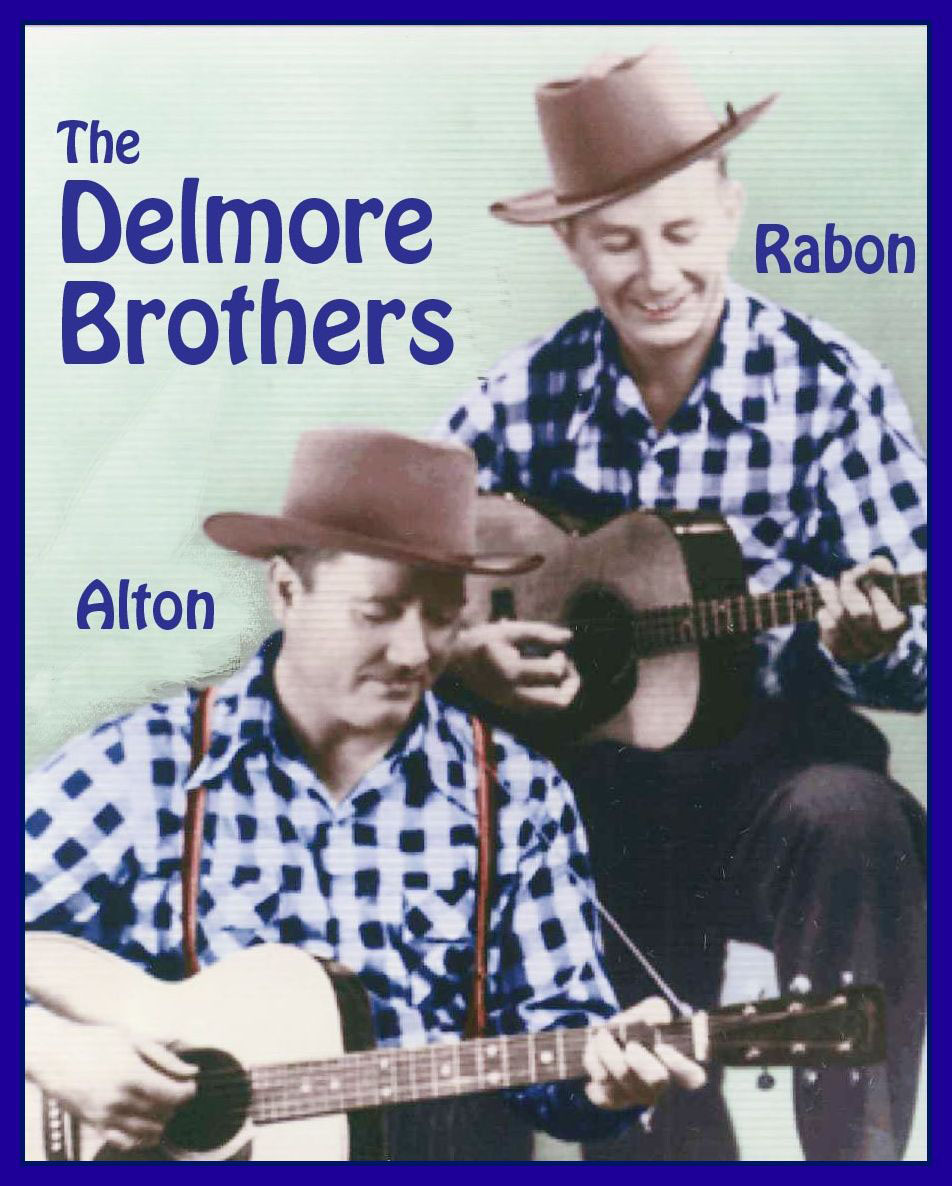
Don’t Forget The Delmore Brothers

I usually shy away from posting on bands or performers for whom I can’t find video. After all, seeing the acts is as much fun and illuminating as hearing them. But in the case of the Alton and Rabon Delmore — The Delmore Brothers — the absence of video is unfortunate but not a reason to skip them. They are extremely important, though not as well remembered as some other early country bands. They also are terrific.

There are very good sites dedicated to the brothers. One is maintained by Alton Delmore’s daughter Debby. Another is The Delmore Brothers Room at Calhoun Community College in Decatur, AL.

CMT puts it well:

The Delmore Brothers are not nearly as well-known as such early country giants as the Carter Family, Jimmie Rodgers, Bob Wills, and Hank Williams. The reasons for this, upon close inspection of their work, are not readily apparent. They were one of the greatest early country harmonizers, drawing from both gospel and Appalachian folk. They were skilled songwriters, penning literally hundreds of songs, many of which have proven to be durable. Most important, they were among the few early traditional country acts to change with the times, and pioneer some of those changes. Their recordings from the latter half of the 1940s married traditional country to boogie beats and bluesy riffs. In this respect they laid a foundation for rockabilly and early rock & roll, and rate among the most important white progenitors of those forms. (Continue Reading…)

There is a very good essay at the YouTube page of the song above, I’ve Got the Deep River Blues. It was written written by a gentleman named Wilson McPhert. Read it by expanding the “show more” button. Here is how it starts:

I am a big fan of Doc Watson’s performance of ‘Deep River Blues’. In finding out about it’s origins, I came across the Delmore Brothers, who did a version in 1933 entitled ‘I’ve Got the Big River Blues’. I really like their close harmony singing and their straightforward approach to music, which morphed from rootsy country ballads to later up tempo tunes which were clearly influential on the development of rock and roll. (Continue Reading…)

Brown’s Ferry Blues, which I believe is an early number, is below.

facebooktwittergoogle_plusredditlinkedinmailby feather

Gillian Welch: The Way It Goes and Elvis Presley Blues

Talent gets handed down in strange ways: Gillian Welch’s parents, according to Wikipedia, were writers for The Carol Brunett Show. Here is part of the profile:

In the early ’90s, Welch attended the Berklee School of Music in Boston, Massachusetts, where she began performing her own material, as well as traditional country and bluegrass songs, as part of a duo with fellow student David Rawlings. After honing their skills in local open mike showcases, the duo began performing regularly throughout the country. While opening for Peter Rowan in Nashville, they were spotted by musician and producer T-Bone Burnett, who helped Welch andRawlings land a record deal. With Burnett producing, they cut 1996′s starkly beautiful Revival, an album split between bare-bones duo performances — some even recorded in mono to capture a bygone sound — and more full-bodied cuts featuring legendary sessionmen like guitarist James Burton, upright bassist Roy Huskey, Jr., and drummers Buddy Harmon and Jim Keltner(Continue Reading…)

Mother Jones did a profile of Welch in its July/August 2011 issue. This is how it starts:

“We’re insane,” says Gillian Welch with a laugh. She’s in Los Angeles, taking a break from finalizing the cover art for The Harrow & The Harvest, her first album in eight years—out June 28. She’s decided to have the package letter-pressed, so she’s taking meetings with printers before driving (yes, driving) all the way home to Nashville. “I don’t know many people who take the album more seriously as a piece of art than we do,” she adds. Such a craftsman-like attitude is hardly a surprise coming from Welch, who has established herself as one of the leading figures in American roots music. She was adopted and raised in L.A. by a husband-wife comedy-and-music team, and met Dave Rawlings, her musical soulmate, at Boston’s Berklee College of Music. Over the course of four acclaimed albums and collaborations with artists ranging from The Decemberists (she features prominently on the band’s hit album, The King is Dead) to soul legend Solomon Burke, Welch came to be celebrated for her stripped-down style and plainspoken lyrics. “Acoustic music is alive and well,” she says. “As it mutates, it helps define our place in the pantheon.” (Continue Reading…)

Her guitarist, Dave Rawlings, is terrific as well. This post was suggested by my brother. Above is The Way it Goes and below is Elvis Presley Blues. Here is Welch’s page at NPR.

facebooktwittergoogle_plusredditlinkedinmailby feather

Little Big Town: Tornado and Boondocks

This band fits into the new country category. Here is the start of its Wikipedia profile:

Little Big Town is an American country music vocal group. Founded in 1998, the group has comprised the same four members since its inception: Karen Fairchild, Kimberly Schlapman, Jimi Westbrook, and Phillip Sweet. The quartet’s musical style relies heavily on four-part vocal harmonies, with all four members alternating as lead singers.[1] Westbrook and Sweet also play rhythm guitar. Continue Reading…

facebooktwittergoogle_plusredditlinkedinmailby feather

Steve Goodman: City of New Orleans and Talk Backwards

Here is a guest post from my cousin Ed:

Steve Goodman was a very talented songwriter who wrote a number of songs with which we’re familiar.  Above is a young Steve Goodman performing the probably the most well known of the batch — The City of New Orleans — which was written on a train of the same name. He noted:

“I looked out the window and I wrote down some stuff and it rhymed. It didn’t take too much more than that – about a half an hour.  Sometimes you get visited by songs.  You don’t have too much to do with them – they just show up.”  It was the song played for the astronauts on Apollo 11 to wake them every morning.  See an interview about this and other things here.

Goodman created his own big break:

Seeing Arlo Guthrie in a bar, Goodman asked to be allowed to play a song for him. Guthrie grudgingly agreed on the condition that Goodman buy him a beer first; Goodman played “City of New Orleans” which Guthrie liked enough that he asked for the right to record it. Guthrie’s version of the song became a hit in 1972, and provided Goodman with enough financial success to make his music a full-time career. The song would become an American standard, covered by many other musicians including Johnny Cash, Judy Collins, and Willie Nelson.

Steve also wrote a number of humorous songs.  Here’s an excerpt from an interview (link to full interview above) where he talked about how he came to write Talk Backwards (below) and then performs it.  Steve also wrote a song about “the sad story of a man who falls asleep with his television on and has visions…”

Steve was a big Cubs fan and he wrote two songs about that.  To read more about Steve, see his bio here.

facebooktwittergoogle_plusredditlinkedinmailby feather